
A complete roofing estimate shows the scope in plain words, line items with quantities and unit prices, the squares those quantities came from, decking exclusions with a change-order rate, deposit and validity terms, and one total the customer can check with a calculator. Below is a filled-in example — the same structure Voice Estimate builds from a spoken walkthrough.
Search "roofing estimate example" and you mostly get blank templates. A blank template shows you where the boxes go; it doesn't show what the filled-in lines look like when the math has to hold up. So this page is one complete estimate — a 2,400 sq ft architectural shingle replacement — with every number checkable and the takeoff behind it shown.
What does a complete roofing estimate look like?
A complete roofing estimate has eight parts: your business info and license number, the customer name and job address, the estimate number with date and validity, a scope of work, line items with quantities and unit prices, assumptions, exclusions with a decking change-order rate, and acceptance terms with the total and a signature line.
The general anatomy — any trade, section by section — is in our guide to writing a job estimate. Here's what each part earns on a roof specifically:
| Section | What it does on a roofing estimate |
|---|---|
| Business name, contact, license number | Roofing is a licensed trade in most states — the number belongs on anything you hand a customer |
| Customer name and job address | Ties the price to one roof, one pitch, one access situation — not "a 2,400 sq ft roof" in the abstract |
| Estimate number, date, valid-until date | Makes the document referenceable and puts an expiration on the price before material costs move |
| Scope of work | Replace or repair, how many layers off, what goes on — in words the customer can repeat back |
| Line items: description, quantity, unit price | Shows the math. A total backed by visible squares gets challenged less because it can be checked |
| Assumptions | One existing layer, dumpster access, no structural surprises — what the price takes for granted |
| Exclusions | The decking clause lives here: what hidden damage costs per sheet and how it gets approved |
| Terms, total, signature line | Deposit as a condition of acceptance, the validity window, one number, one place to say yes |
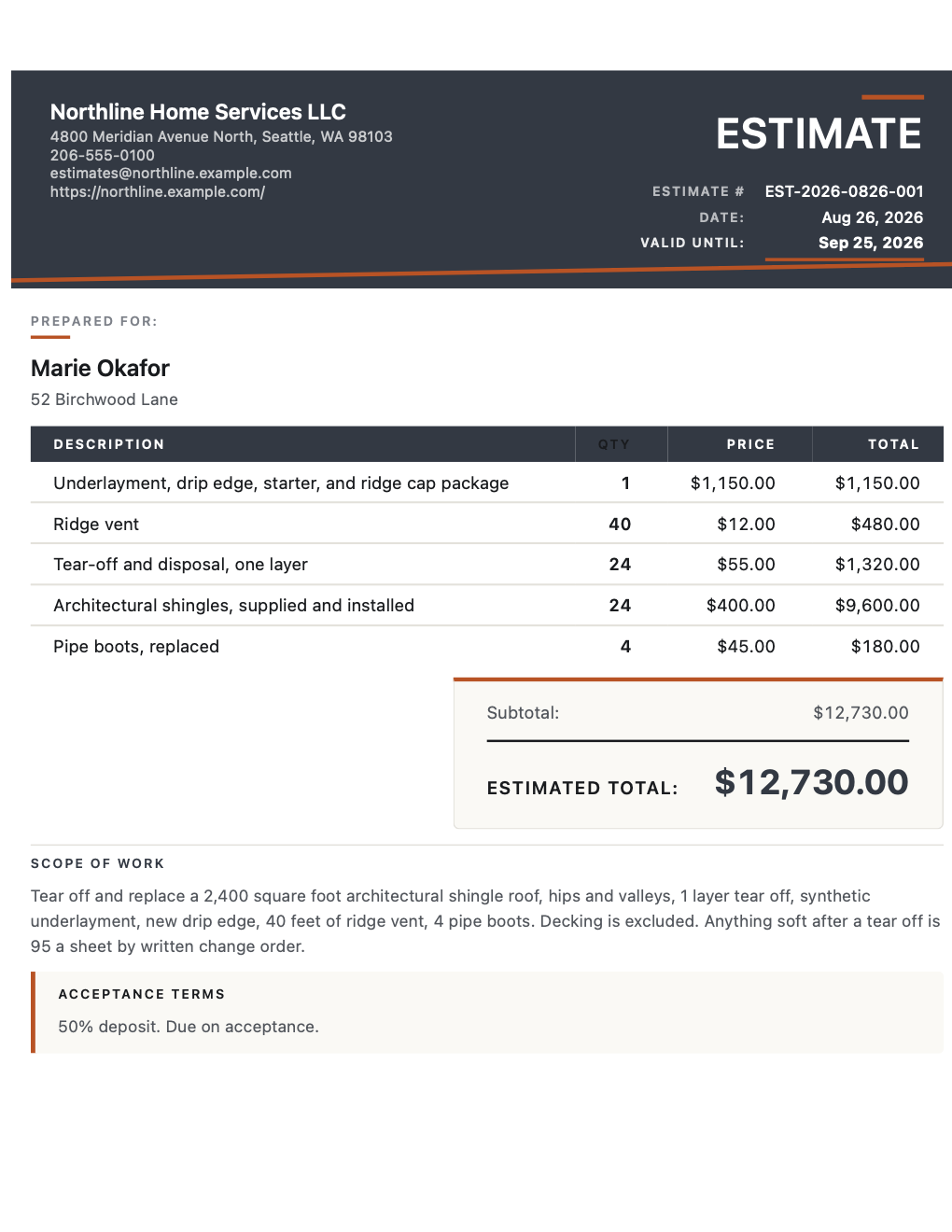
The example: 2,400 sq ft architectural shingle replacement
The job: tear off one layer of asphalt shingles on a 2,400 sq ft hip roof with two valleys, install synthetic underlayment, architectural shingles, new drip edge, 40 feet of ridge vent, and four pipe boots. Walkable pitch, driveway access for the dumpster.
The scope of work, as written on the estimate: "Tear off one layer of asphalt shingles and dispose. Install synthetic underlayment, architectural shingles, new drip edge at eaves and rakes, 40 LF ridge vent, and four replacement pipe boots. Site magnet-swept on completion."
The line items, priced at this contractor's example rates — the rates are the part that's yours; no software should be inventing them:
| Line item | Qty | Unit price | Line total |
|---|---|---|---|
| Tear-off and disposal, one layer | 24 SQ | $55.00 | $1,320.00 |
| Architectural shingles, supplied and installed | 24 SQ | $400.00 | $9,600.00 |
| Synthetic underlayment, drip edge, starter, ridge cap | 1 | $1,150.00 | $1,150.00 |
| Ridge vent, installed | 40 LF | $12.00 | $480.00 |
| Pipe boots, replaced | 4 | $45.00 | $180.00 |
| Total | $12,730.00 |
Below the line items, the sections that do the protecting:
- Exclusions: "No decking replacement included. Sheets found soft or delaminated after tear-off are priced at $95 per sheet of 7/16" OSB, approved in writing before installation continues."
- Assumptions: "Assumes one existing shingle layer and driveway access for the dumpster. Satellite dish removal and re-mounting not included."
- Terms: "50% deposit due on acceptance, balance on completion. This estimate is valid for 30 days from the date above."
Every number checks: 24 × $55 is $1,320, 24 × $400 is $9,600, 40 × $12 is $480, 4 × $45 is $180, and the five line totals sum to $12,730. All-in, that's about $530 a square — inside the roughly $200 to $700 per installed square that HomeGuide's 2026 cost data reports nationally, a band that wide because pitch, access, layers, and region all move it. The sanity check is the range; the price is your rates.
Note what the deposit line is doing: it's a condition of acceptance, not money received. Nothing gets subtracted from the $12,730, because nothing has been paid — the estimate sets the term, and the bookkeeping starts after the customer signs.
The takeoff math behind the line items
The quantities in that table aren't decoration — they're the output of a takeoff anyone can redo. Area to squares: 2,400 ÷ 100 = 24 squares. Waste: this roof has hips and valleys, so 15% instead of the 10% a simple gable gets. Shingles: 3 bundles per square for standard architectural profiles.
2,400 SQ FT · HIPS + VALLEYS · 15% WASTE
83 BUNDLES
2,400 ÷ 100 = 24 squares. Bundles: 24 × 3 × 1.15 = 82.8, rounded up to 83. Synthetic underlayment at 10 squares a roll: 24 ÷ 10 = 2.4, rounded up to 3 rolls. Quantities to order against — the prices stay yours.
In Voice Estimate, that math runs on the server from the numbers you spoke — the AI extracts "2,400 square feet" and "fifteen percent waste" literally, and code does the dividing and rounding. The roofing calculator outputs materials and quantities, never prices, and an unpriced suggestion never enters your total. If it ran with a default you didn't state — say it assumed a waste factor — the draft carries a review warning naming the assumption: fine if that's your roof, one tap to change if it isn't.
The full takeoff walkthrough — pitch, layers, penetrations, what to capture while you're still on-site — is in how to price a roof job by voice.
Dictating this estimate: a voice script
Here's the whole example as one recording, made in the driveway instead of at the kitchen table:
"Estimate for Marie Okafor at 52 Birchwood Lane. Tear off and replace a 2,400 square foot architectural shingle roof, hips and valleys, fifteen percent waste. One layer tear-off, synthetic underlayment, new drip edge, forty feet of ridge vent, four pipe boots. Tear-off and disposal is fifty-five a square. Shingles supplied and installed are four hundred a square. Underlayment, drip edge, starter, and ridge cap package is one thousand one hundred fifty dollars. Ridge vent is twelve dollars a linear foot. Pipe boots are forty-five each. Decking is excluded — anything soft after tear-off is ninety-five a sheet by written change order. Fifty percent deposit due on acceptance, and the price is good for thirty days."
Where each phrase lands: "2,400 square foot" and "fifteen percent waste" become measurements, and the server turns them into 24 squares and 83 bundles — the AI is never asked to do arithmetic. The rates are your spoken prices, extracted as the literal numbers you said. "Fifty percent deposit due on acceptance" lands in the acceptance terms as a condition of the job, and "good for thirty days" sets the validity date because you actually said it. One dictation habit worth keeping: say "one thousand one hundred fifty dollars," not "eleven fifty" — you know which one you meant; a transcript can read it two ways.
Common mistakes on roofing estimates
- A bare total. "$12,730" with no squares behind it reads as a guess even when it isn't. The customer comparing three bids can check yours — that's an advantage, not a risk.
- No decking language. Every tear-off can reveal soft sheets, and an estimate silent on the subject either eats the repair or starts a fight. A per-sheet rate and a written-approval clause costs you two sentences.
- Waste left unstated. If the estimate says 24 squares and the material order says 83 bundles, the gap needs to be on paper. "15% waste, hips and valleys" is the whole explanation.
- A deposit with no timing. "50% deposit" alone doesn't say when. "Due on acceptance, balance on completion" makes it a condition of starting — a term of the job, not a payment that's already happened.
- No validity date. Shingle and underlayment prices move. An estimate without an expiration is an offer to hold today's price for whenever the customer gets around to deciding.
What to review before you send
- Squares, waste factor, and bundle math match what your tape and your eyes said on the roof
- Tear-off layers, disposal, and access are stated, not assumed
- The decking rate and its written-approval mechanism are in the exclusions
- Ventilation and flashing scope is named — ridge vent footage, boots, drip edge
- Deposit is worded as a condition of acceptance, with the balance timing stated
- The validity date is on the document
- Your license number is on it, and the total is the number you meant
FAQ
What should be included in a roofing estimate?
Eight parts: your business info and license number, the customer name and job address, an estimate number with date and validity, a scope of work, line items with quantities and unit prices, assumptions, exclusions — including how hidden decking damage gets priced — and terms: deposit wording, plus the total with a signature line.
How many bundles of shingles do I need per square?
Three bundles cover one square (100 sq ft) for standard three-tab and most architectural shingles; some heavier premium profiles take four or more. Multiply squares by three, add your waste factor — 10% on a simple gable, 15% with hips and valleys — and round up to whole bundles.
What waste percentage should a roofing estimate use?
10% on a simple gable roof, 15% when the roof has hips, valleys, dormers, or other cut-up sections that generate offcuts. State the waste percentage on the estimate itself — a quantity with visible waste reads as measured, not guessed, and it explains why the material order lands above the bare area math.
How much does a roof replacement cost per square?
National averages for installed asphalt shingles run roughly $200 to $700 per square, depending on material grade, pitch, access, and region (HomeGuide cost data, 2026). Treat that as a sanity range, not a price: the number on your estimate comes from your labor cost, your overhead, and your margin.
How do roofers estimate decking repairs they can't see?
They don't guess — they exclude. The estimate carries a per-sheet rate and a change-order clause: "decking replacement priced at $95 per sheet, approved in writing after tear-off." That turns the unknown into billable work agreed in advance, and the quoted total stays a number you can stand behind.
How long is a roofing estimate good for?
Thirty days is the common default, and shingle and underlayment prices move often enough that the date belongs on the document. In Voice Estimate the validity date is never invented: if you said "good for 30 days" it's used because you said it, and if you didn't, the app stamps the estimate date plus your default setting.