
A complete fence estimate shows the scope in plain words — footage, height, style, gates — line items with quantities and unit prices, the post-and-picket takeoff behind them, property-line and dig-condition terms, and one total the customer can check with a calculator. Below is a filled-in example, the same structure Voice Estimate builds from a spoken walkthrough.
Search "fence estimate example" and you mostly get blank templates. A blank template shows you where the boxes go; it doesn't show what the filled-in lines look like when the math has to hold up. So this page is one complete estimate — 150 linear feet of 6-foot cedar privacy fence with a gate and a tear-out — with every number checkable and the material takeoff behind it shown.
What does a complete fence estimate look like?
A complete fence estimate has eight parts: your business info and license number, the customer name and job address, the estimate number with date and validity, a scope of work, line items with quantities and unit prices, assumptions about the property line and utilities, exclusions with a dig-condition rate, and acceptance terms with the total and a signature line.
The general anatomy — any trade, section by section — is in our guide to writing a job estimate. Here's what each part earns on a fence specifically:
| Section | What it does on a fence estimate |
|---|---|
| Business name, contact, license number | Fence work is licensed or permit-gated in many states and most cities — the number belongs on anything you hand a customer |
| Customer name and job address | Ties the price to one property line, one slope, one soil condition — not "150 feet of fence" in the abstract |
| Estimate number, date, valid-until date | Makes the document referenceable and puts an expiration on the price before lumber costs move |
| Scope of work | Tear-out or new run, footage, height, style, gate count — in words the customer can repeat back |
| Line items: description, quantity, unit price | Shows the math. A total backed by visible footage and rates gets challenged less because it can be checked |
| Assumptions | Owner confirms the fence line, 811 locates done before dig day, normal diggable soil — what the price takes for granted |
| Exclusions | The dig-condition clause lives here: what rock, roots, or old footings cost per hole and how they get approved |
| Terms, total, signature line | Deposit as a condition of acceptance, the validity window, one number, one place to say yes |
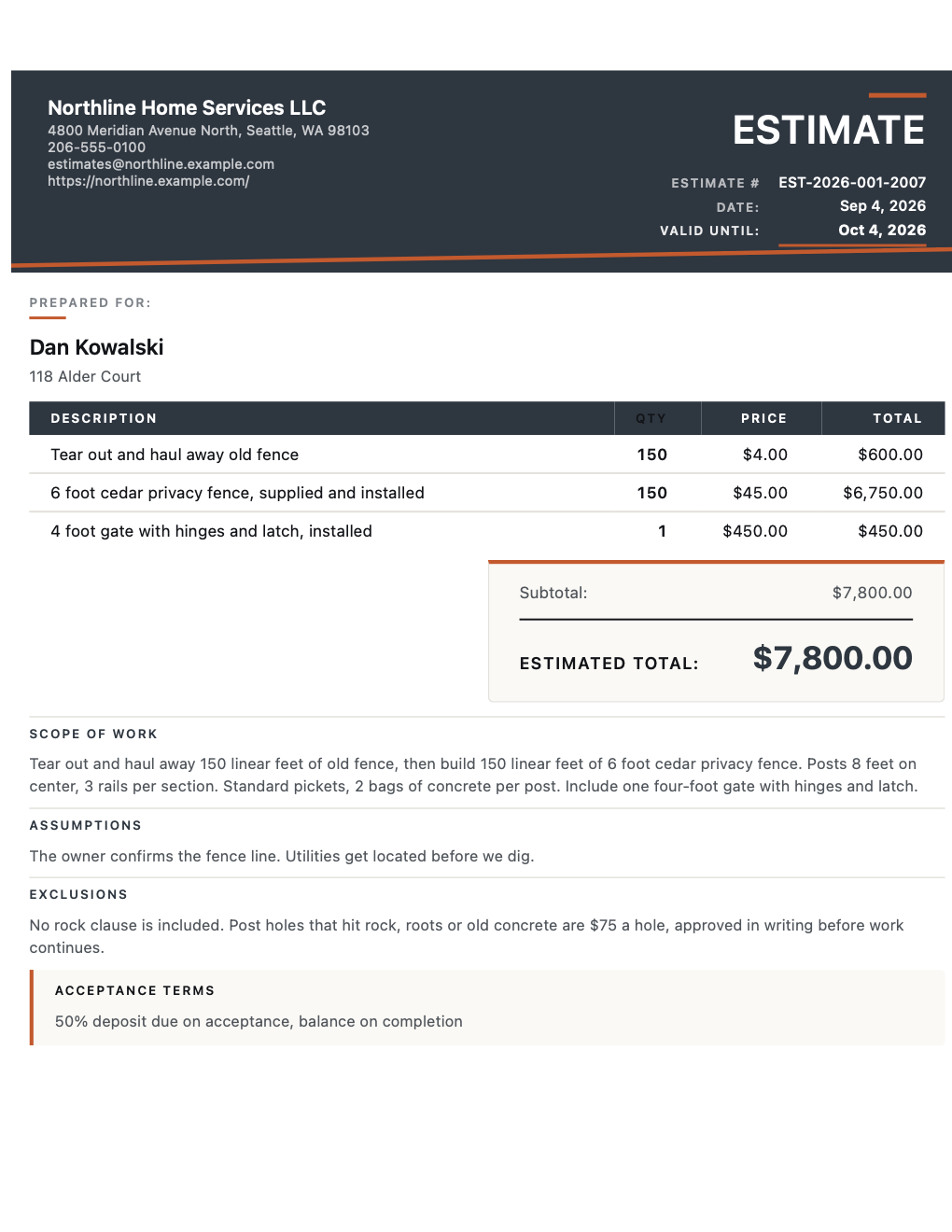
The example: 150 feet of 6-foot cedar privacy fence
The job: tear out 150 linear feet of failing fence, haul it away, and build 150 linear feet of 6-foot cedar privacy fence — posts 8 feet on center, three rails per section, standard pickets, two bags of concrete per post — with one 4-foot gate. Flat run, backyard access through the drive gate.
The scope of work, as written on the estimate: "Tear out and haul away 150 linear feet of old fence, then build 150 linear feet of 6 foot cedar privacy fence. Posts 8 feet on center, 3 rails per section. Standard pickets, 2 bags of concrete per post. Include one four-foot gate with hinges and latch."
The line items, priced at this contractor's example rates — the rates are the part that's yours; no software should be inventing them:
| Line item | Qty | Unit price | Line total |
|---|---|---|---|
| Tear out and haul away old fence | 150 LF | $4.00 | $600.00 |
| 6-ft cedar privacy fence, supplied and installed | 150 LF | $45.00 | $6,750.00 |
| 4-ft gate with hinges and latch, installed | 1 | $450.00 | $450.00 |
| Total | $7,800.00 |
Below the line items, the sections that do the protecting:
- Exclusions: "No rock clause is included. Post holes that hit rock, roots or old concrete are $75 a hole, approved in writing before work continues."
- Assumptions: "The owner confirms the fence line. Utilities get located before we dig."
- Terms: "50% deposit due on acceptance, balance on completion." The valid-until date sits in the header: dated Sep 4, good until Oct 4.
Every number checks: 150 × $4 is $600, 150 × $45 is $6,750, and the three line totals sum to $7,800. The install line at $45 a foot sits inside the roughly $25 to $50 per linear foot that HomeGuide's cost data reports for an installed 6-foot wood privacy fence as of September 2026, with cedar running toward the upper half. The sanity check is the range; the price is your rates.
Note what the deposit line is doing: it's a condition of acceptance, not money received. Nothing gets subtracted from the $7,800, because nothing has been paid — the estimate sets the term, and the bookkeeping starts after the customer signs.
The takeoff math behind the material order
The estimate prices the job per foot, but the truck gets loaded from a takeoff anyone can redo:
- Sections: 150 ÷ 8 = 18.75, rounded up to 19 sections.
- Posts: 19 + 1 to close the run = 20, plus 2 for the gate = 22.
- Rails: 19 × 3 = 57 — three rails per section on a 6-foot fence; 5-foot and under gets two.
- Pickets: 150 ft × 12 = 1,800 inches ÷ 5.5-inch picket = 328, plus 2% cull for the warped and split ones = 335.
- Concrete: 22 posts × 2 bags = 44 fifty-pound bags.
150 LF PRIVACY FENCE · 6 FT · 1 GATE
22 POSTS · 44 BAGS
19 sections at 8 ft on center. Rails: 19 × 3 = 57. Pickets: 328 + 2% cull = 335. Concrete: 22 × 2 = 44 bags. Quantities to order against — the prices stay yours.
In Voice Estimate, that math runs on the server from the numbers you spoke — the AI extracts "150 linear feet" and "one four-foot gate" literally, and code does the dividing and rounding. The fence calculator outputs materials and quantities, never prices: the gate hardware kit appears as an unpriced suggestion, and an unpriced suggestion never enters your total. If the calculator ran with a default you didn't state — the 8-foot spacing, say — the draft carries a review warning naming the assumption: fine if that's your fence, one tap to change if it isn't.
Want to run this math on your own numbers? The fence material calculator is free, no signup — same defaults, quantities only.
The full walkthrough — grade changes, corners, soil, demo, what to capture while you're still on the fence line — is in how to price a fence job by voice.
Dictating this estimate: a voice script
Here's the whole example as one recording, made standing at the last post location instead of back at the kitchen table:
"Estimate for Dan Kowalski at 118 Alder Court. Tear out and haul away 150 linear feet of old fence, then build 150 linear feet of six-foot cedar privacy fence. Posts eight feet on center, three rails per section, standard pickets, two bags of concrete per post. Include one four-foot gate with hinges and latch. Demo is four dollars a linear foot. Fence supplied and installed is forty-five dollars a linear foot. The gate is four hundred fifty dollars installed. Exclusions. No rock clause is included. Post holes that hit rock, roots, or old concrete are seventy-five dollars a hole, approved in writing before work continues. Assumptions. The owner confirms the fence line. Utilities get located before we dig. Terms. Fifty percent deposit due on acceptance, balance on completion. The price is good for thirty days."
Where each phrase lands: "150 linear feet" becomes a measurement, and the server turns it into 19 sections, 22 posts, 57 rails, 335 pickets, and 44 bags — the AI is never asked to do arithmetic. The rates are your spoken prices, extracted as the literal numbers you said. "Fifty percent deposit due on acceptance" lands in the acceptance terms as a condition of the job, and "good for thirty days" sets the validity date because you actually said it. Naming the sections out loud — "exclusions," "assumptions," "terms" — files each line where it belongs. One dictation habit worth keeping: say "four hundred fifty dollars," not "four fifty" — you know which one you meant; a transcript can read it two ways.
Common mistakes on fence estimates
- A bare lump sum. "$7,800" with no footage or rate behind it reads as a guess even when it isn't. The customer comparing three bids can check yours — that's an advantage, not a risk.
- Silence on the property line. The most expensive fence mistake is building a straight, plumb, beautiful fence on the neighbor's side of the line. One assumption line — owner confirms the line, survey if in doubt — moves that risk where it belongs.
- No dig-condition language. You can't see rock, roots, or the previous fence's footings from the surface. A per-hole rate with written approval costs you two sentences; hitting concrete on hole six with no clause costs you the afternoon.
- Gates priced as an afterthought. A gate is two extra posts, hardware, and the only part of the fence that moves — which makes it the part that gets complained about. Its own line, its own price.
- No validity date. Cedar and pressure-treated prices move. An estimate without an expiration is an offer to hold today's lumber price for whenever the customer gets around to deciding.
What to review before you send
- Footage, height, and style match what your wheel measured on the walk
- Post spacing and rails per section are stated, not assumed
- Gate count, sizes, and hardware are on their own lines
- Property-line confirmation and the 811 locate are in the assumptions
- The rock-and-roots rate and its written-approval mechanism are in the exclusions
- Demo and haul-away are explicitly in or explicitly out
- Deposit is worded as a condition of acceptance, the validity date is on the document, and the total is the number you meant
FAQ
What should be included in a fence estimate?
Eight parts: your business info and license number, the customer name and job address, an estimate number with date and validity, a scope of work naming footage, height, style, and gates, line items with quantities and unit prices, assumptions — property line and utility locates — exclusions with a dig-condition rate, and terms: deposit wording, the total, and a signature line.
How many posts do I need for 150 feet of fence?
At the standard 8-foot spacing, 150 feet of fence needs 20 posts: 150 ÷ 8 rounds up to 19 sections, plus one post to close the run. Each gate adds two more, so 150 feet with one gate is 22 posts. Corners consume posts too — count them on the walk, not at the supplier.
How much concrete do I need per fence post?
Two 50-pound bags per post is the standard for a 4x4 post in an 8–10 inch hole dug 24–30 inches deep. Corner, end, and gate posts carry the most load — give them an extra bag. For a 150-foot privacy fence with one gate, that's 22 posts × 2 bags = 44 bags on the truck.
Should gates be priced separately on a fence estimate?
Yes. A gate is its own line item with the hardware named — hinges, latch, drop rod if it's a double. It also changes the material order: each gate adds two posts, set in concrete like any other. A fence priced per foot with the gate "included" hides your most labor-dense work inside your cheapest rate.
How much does a wood privacy fence cost per linear foot?
National averages for a 6-foot wood privacy fence run roughly $25 to $50 per linear foot installed, with cedar toward the upper half of that band (HomeGuide cost data, accessed September 2026). Treat it as a sanity range, not a price: the number on your estimate comes from your labor cost, your overhead, and your margin.
Who marks the property line before a fence job?
The owner confirms the property line — by survey if there's any doubt — and the contractor calls 811 for utility locates before digging. Put both in the estimate's assumptions. A fence built even a foot onto the neighbor's side can be rebuilt at your expense, so the line gets settled in writing, not on dig day.